This site shows you lots of java programming knowledge. you can learn java coding easily.Java language is easy when you understand with right kind of knowledge.
How to Create a Java Servlet Using Eclipse?
Get link
Facebook
X
Pinterest
Email
Other Apps
-
1.Create a New Dynamic Web Project in Eclipse
2.Create Servlet in Eclipse
Project--> Java Resources -->Src -->New-->Servlet
3.Give Java Package and Class Name then Click Finish.
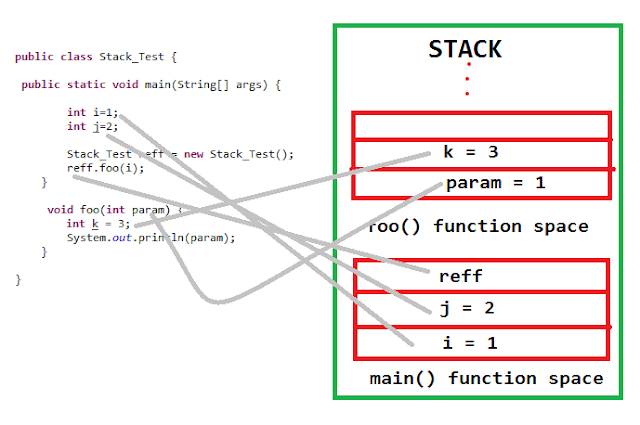
Stack Memory Stack in java is a section of memory which contains methods, local variables, and reference variables. Local variables are created in the stack. Java Stack memory is used for the execution of a thread. They contain method-specific values that are short-lived and references to other objects in the heap that is getting referred from the method. Stack memory is always referenced in LIFO (Last-In-First-Out) order. Whenever a method is invoked, a new block is created in the stack memory for the method to hold local primitive values and reference to other objects in the method. As soon as the method ends, the block becomes unused and becomes available for the next method. Stack memory size is very less compared to Heap memory. Key Features of Stack Memory Apart from what we have discussed so far, following are some other features of Stack memory: It grows and shrinks as new methods are called and returned respectiv...
In this tutorial explain to What is Class Loader? Types of Class Loader. Principle of Class Loader. Class Loader hierarchy. ClassLoader The class loader concept, one of the cornerstones of the Java virtual machine , describes the behavior of converting a named class into the bits responsible for implementing that class. Because class loaders exist, the Java run time does not need to know anything about files and file systems when running Java programs. The Java ClassLoader is a part of the Java Runtime Environment that dynamically loads Java classes into the JavaVirtual Machine . The Java run time system does not need to know about files and file systems because of classloaders. Java classes aren’t loaded into memory all at once, but when required by an application. At this point, the Java ClassLoader is called by the JRE and these ClassLoaders load classes into memory dynamically. Types of C...



Comments
Post a Comment